> For the complete documentation index, see [llms.txt](https://docs.zerowork.io/llms.txt). Markdown versions of documentation pages are available by appending `.md` to page URLs; this page is available as [Markdown](https://docs.zerowork.io/using-zerowork/using-selectors/use-elements-text.md).
# Use Element's Text
If the element you want to address has unique text, you can address that element by that text. For example, if you want to automatically like a page on Facebook, you can make your TaskBot find and click on a button with text "Like".
### **Exact Match**
#### **text="Enter exact text of the element" (inside the double quotes)**
If you enter text inside double quotes, as shown below, your TaskBot will search for an element that matches exactly this text.
text="some text"\
\
Note: This option is case-sensitive!
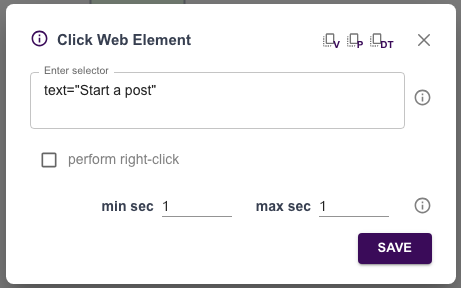
For example, assume you want to start a post on LinkedIn, and the button on LinkedIn is called "Start a post".

In this case, you can create a selector like this:
### **Loose Match**
#### **text=Enter some keyword of the text (without double quotes)**
If you enter text without double quotes, as shown below, your TaskBot will search for an element whose text contains the text you provided.
text=some keyword that the text contains
For example, assume you want to save the number of followers from a Facebook business page, and the information on the page contains a text that says *1,456 people follow this*.

\
As the number itself changes dynamically depending on the popularity of the page, you cannot use text="1,456 people follow this" (with double quotes) but you can use the keyword *people follow this*. Simply skip double quotes like shown here:
text=people follow this
### Video Tutorial: Example of Using text="" and text=
{% embed url="" %}